Isar Aerospace’s Spectrum rocket reaches orbit on its second flight
The German company says its Spectrum rocket deployed payloads from Norway, giving Europe a new privately developed commercial route to orbit.
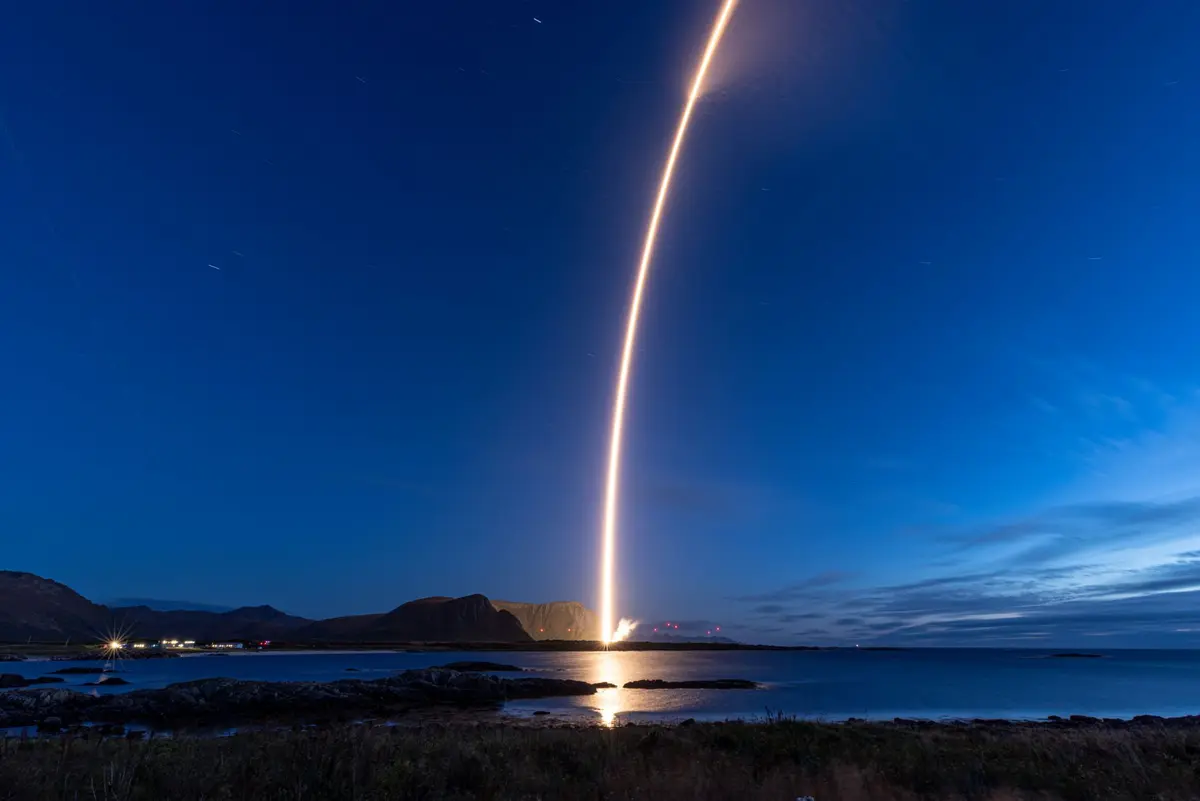
Isar Aerospace has made European launch history: its Spectrum rocket reached orbit and deployed customer payloads on only its second flight, giving the continent a privately developed commercial orbital option from continental Europe.
The Onward and Upward mission lifted off from Isar’s launch complex at Andøya Space in Norway at 10:12pm CEST on 5 September 2026. Isar says the vehicle reached orbit and completed spacecraft separation successfully, while the company works with customers to confirm the status of the satellites.
What’s actually going on
Spectrum completed the key steps of the flight, including passing Max Q, main-engine cutoff, stage separation and second-stage ignition. Isar says it crossed the 100-kilometre Kármán line, jettisoned its payload fairing, reached orbital velocity and completed its circularisation burn before separating the spacecraft.
The payloads were selected through the German Space Agency at DLR’s Microlauncher Competition, which provides educational institutions and start-ups with lower-cost access to space. The programme is funded through ESA Boost! — so this was a commercial launch with a distinctly European pipeline behind it.
Isar describes the flight as a qualification mission and says it is the first commercial space company from Europe to successfully deliver satellites into orbit. Ars Technica similarly describes Spectrum as the first fully commercial European launch vehicle to reach orbit. That distinction matters: Europe has long had orbital launch capability through established state-backed programmes, but Isar is demonstrating a privately funded route aimed at commercial customers.
Why you should care
Launch access is a bottleneck for satellite operators. A successful European commercial rocket gives institutional and private customers another option and reduces the need to rely exclusively on providers elsewhere. It also supports Europe’s wider push for strategic autonomy in space, although one successful orbital mission does not yet equal a mature, high-cadence service.
Isar says Spectrum vehicles three through seven are already in production. The company is also nearing completion of a 40,000-square-metre integrated production facility, which it says will eventually be able to manufacture up to 40 launch vehicles per year. Those are ambitious scale targets, not flight-proven capacity, and the next challenge is turning this breakthrough into reliable repetition.
The company is expanding beyond Andøya as well. Isar is constructing a launch complex in Nova Scotia, Canada, intended to cover mid- to high-inclination orbits useful for Earth-observation and communications missions. Its order pipeline and production plans will now receive far more scrutiny from prospective customers, investors and European policymakers.
Our opinion
This is a genuinely important European technology story because Isar has cleared the hardest psychological and engineering barrier: Spectrum has not merely left the launch pad, it has reached orbit and delivered payloads. Europe now has a new commercial launch contender with a real mission behind it rather than a glossy roadmap.
But the asterisk is substantial. Isar still needs to prove repeatability, turnaround time, payload accuracy and commercial pricing across multiple flights. One success can open the door; only a dependable launch cadence will keep customers walking through it.
Sources: Isar Aerospace official mission release, The Verge and Ars Technica.