Google's Health Guardian goes live on Pixel Watch
Blood pressure, insulin resistance and sleep breathing trends have started rolling out to Pixel Watch owners, free on three models and behind a subscription on Fitbit Air.
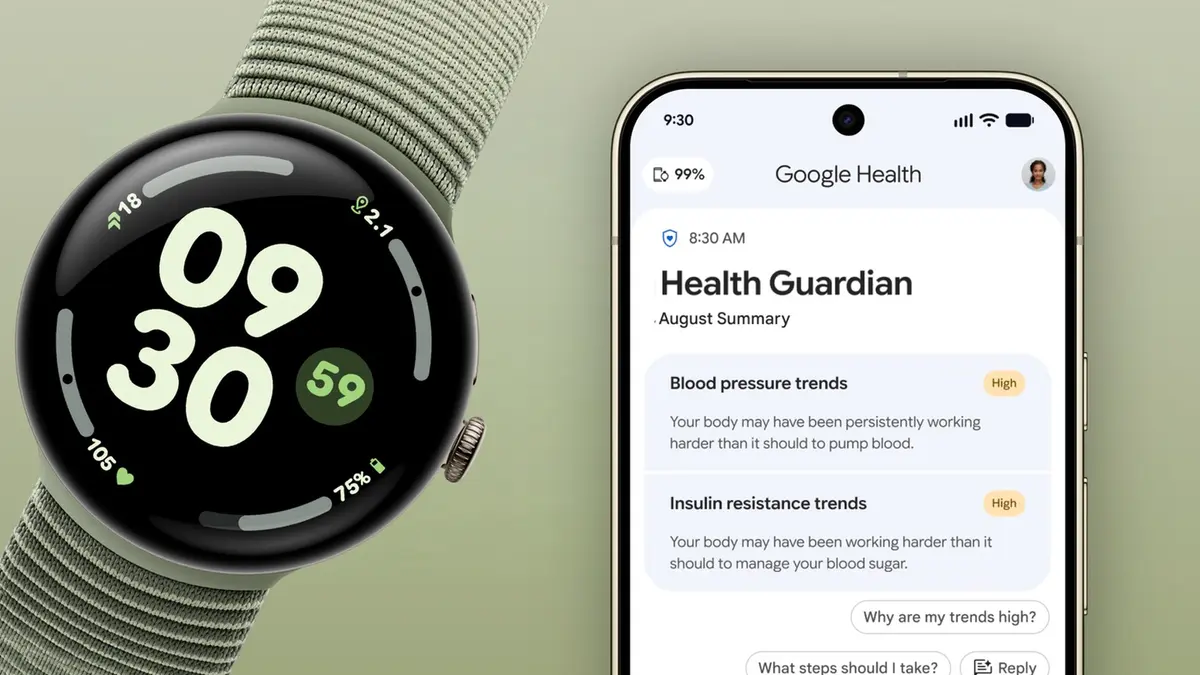
Google has started rolling out Health Guardian, a set of proactive health tools that live in the Google Health app and read the sensors on a Pixel Watch. Blood pressure trends, insulin resistance trends and sleep breathing quality can be set up in the app from this week, with the first trend reports promised for early October.
What's actually going on
The features are free with a Pixel Watch 3, 4 or 5. Owners of the cheaper Fitbit Air will get insulin resistance and blood pressure trends with a Google Health Premium subscription later this year, so the same wrist data sits behind a paywall on one device and not on another. Trend insights arrive on the first of each month: insulin resistance needs at least seven days of data in a month, and blood pressure trends need at least five consecutive days in a week.
The safety headline is Breathing Emergency Detection, which Google limits to Pixel Watch 4 and 5 in select European countries. It watches for severe drops in blood oxygen and can prompt a call to emergency services. Google says it has been CE-marked in the EU but has not been cleared or evaluated by the FDA.
The caveats are unusually thorough for a consumer health launch. Google states that the tools are for general wellness and informational purposes only, that they are not intended to diagnose, treat, cure or prevent any condition, and that they are not a prescreener for diabetes, hypertension or sleep apnoea. The company also says they should not be used to adjust medication or treatment plans, and should not be used by anyone who is pregnant.
Why you should care
Wearables have spent a decade counting steps and heart rate. Trend features are the next step: instead of a single reading at three in the morning, the watch watches the shape of your week and tells you something is drifting. That is a far more useful product and a far riskier claim, because a trend is an interpretation, and interpretations can be wrong in ways a pulse count cannot.
Blood pressure is the interesting one. Cuffless blood pressure from a wrist sensor is one of the genuinely hard problems in consumer health hardware, and Google's own wording is careful here: these are trends and metrics, not real-time clinical readings.
Our opinion
Free on three generations of Pixel Watch and behind a subscription on Fitbit Air is the detail worth remembering, because it shows where Google thinks the value sits. The watch is the sensor; the interpretation is the product. That is a sensible business and an awkward promise, since the same wrist, the same data and the same algorithm produce a high blood pressure trend in both cases. The trend itself is a nudge, not a diagnosis, and Google's footnotes say so at length. What those footnotes do not answer is the question a user will actually ask when the card turns amber: is this real, and what should I do about it? Wellness-only is a legal answer to that, not a useful one. The maths is safer than the interface.