Google Arts & Culture turns 15 with an AI-rebuilt app
Google's culture platform has turned 15 and rebuilt its mobile app around a conversational search, two AI experiments and an expanded city guide.
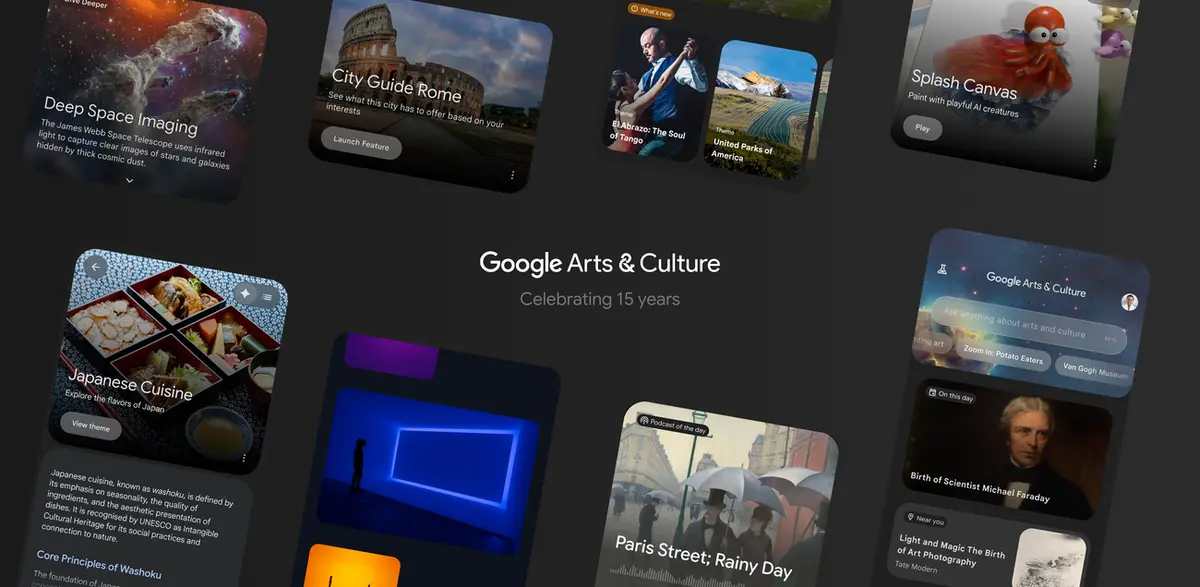
Google Arts & Culture turned 15 on 28 September and marked the birthday by rebuilding its mobile app around a conversational search that answers questions about art and history with pictures and stories drawn from partner archives.
What the anniversary update changes
The relaunched homepage collapses the whole app into one feed. Modular sections surface short cultural stories and daily highlights next to the interactive features, so the app now opens on something to look at rather than a menu of categories.
Two AI experiments sit inside that feed. Chrono Look lets you try on historical clothing from different eras and regions, moving from rough sketches to finished renderings. Dial-an-Artist simulates a conversation with a historical artist about their work, which is the sort of thing that either sparks a genuine detour into an artist's life or produces a plausible-sounding parody of one.
The city guide has also grown, adding 27 destinations with local cultural recommendations layered on top of the landmark listings.
Fifteen years and 3,000 partners
Google says the project has worked with more than 3,000 cultural institutions and artists across more than 90 countries since 2011. That partner archive is what the new search is querying: high-resolution artworks, archaeological 3D artefacts, fashion, performance art, sports, craft, culinary heritage, natural history, science, design and nature.
The updated app is rolling out globally from 28 September on Google Play and the Apple App Store, so the redesign should be waiting for anyone who updates.
Our opinion
Fifteen years is a long time to keep a cultural archive alive, and the anniversary is a reminder that the hard part of Google Arts & Culture was never the software. It was the 3,000 handshakes with museums, galleries and estates that put licensed, credited, high-resolution material online. A conversational layer is only as good as the shelf behind it, and that shelf is the asset nobody can clone in an afternoon. The AI experiments are the part to watch with one eye closed: trying on a Regency coat is fun for a minute, and simulated chats with dead painters risk turning scholarship into a party trick. If those features pull people towards the partner collections rather than away from them, the birthday update will have earned its place. If they become the destination, the app has traded an archive for a novelty.