CMA backs a yearly search choice on Android and Chrome
The CMA has strengthened its proposals to give Android and Chrome users in the UK a choice of search service on first use, with an annual prompt and AI assistants eligible for the first time.
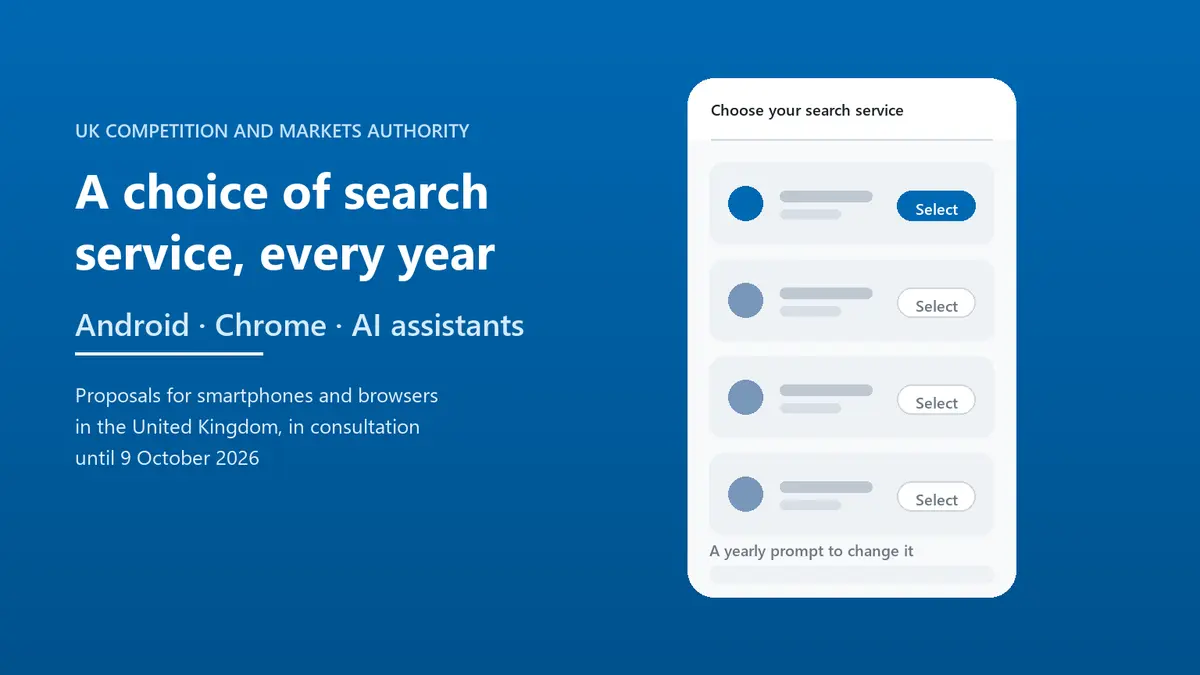
The Competition and Markets Authority has strengthened its proposals to give people in the UK a choice of search service on Android phones and in Chrome, and for the first time it wants AI assistants to sit on the same choice screen as conventional search engines.
What the CMA wants Google to do
Under the updated proposals, published on 23 September, Google would have to give Android and Chrome customers a choice of search services when they use an Android phone or open Chrome for the first time. A prompt would then follow every year, so people can change the default provider they use instead of staying with the decision they made when the device was set up.
A second requirement opens the choice screen to AI assistants, which would be listed where they meet the relevant criteria, including technical and security requirements. The third requires search providers appearing on a choice screen to attribute publisher content fairly, so that readers can reach the original source and see where a result came from.
Why the proposals changed
The regulator says the updated plans reflect how quickly search behaviour has moved, with services such as ChatGPT and Perplexity taking on work that used to begin with a search box. It adds that it has listened to feedback from publishers, search providers and consumer groups.
Sarah Cardell, chief executive of the CMA, said: “We’ve listened carefully to feedback and are responding quickly to the rise of AI assistants, which people are increasingly using as their search service, but aren’t included on Google’s choice screens.” She added that the change is about future-proofing the options available to people in the UK so they can choose the search service they want as new ones reach the market.
What happens next
The CMA is inviting views on the updated proposals until 9 October and expects to reach a final decision on the conduct requirement by the end of the year. Google was designated with strategic market status in general search and search advertising in October 2025. The CMA imposed publisher controls over AI features in search results on 3 June and fair ranking and data portability requirements on 17 June, and is consulting on the strengthened user choice measures from today.
Our opinion
Treating an AI assistant as a search service is the part of this package that will matter most. A choice screen built only from conventional engines would already look dated, and the CMA is the first regulator to write the newer services into the mechanism rather than arguing about them afterwards. Putting the attribution duty on the choice screen is the more useful place for it too: publishers have spent a year complaining that AI answers absorb their work without sending anyone back to it, and a rule that attaches at the moment a reader picks an assistant reaches further than one that only governs the results page.
The annual prompt is the quieter but sharper idea. A choice screen shown once, at set-up, is easy to live with and easy to price into a distribution deal; a question asked again every year is not, because it reopens a decision that default agreements are built to close. Against that, this is still a consultation and not an order, and Google will argue that the existing design already works at scale. The real test arrives with the final decision promised for the end of the year: whether the yearly prompt and the assistants both survive it.