Canonical's Devpack for Rust puts a toolchain in one snap
Canonical has published Devpack for Rust, a snap that installs Rustup, an IDE and a curated set of command-line tools in a single command on Ubuntu.
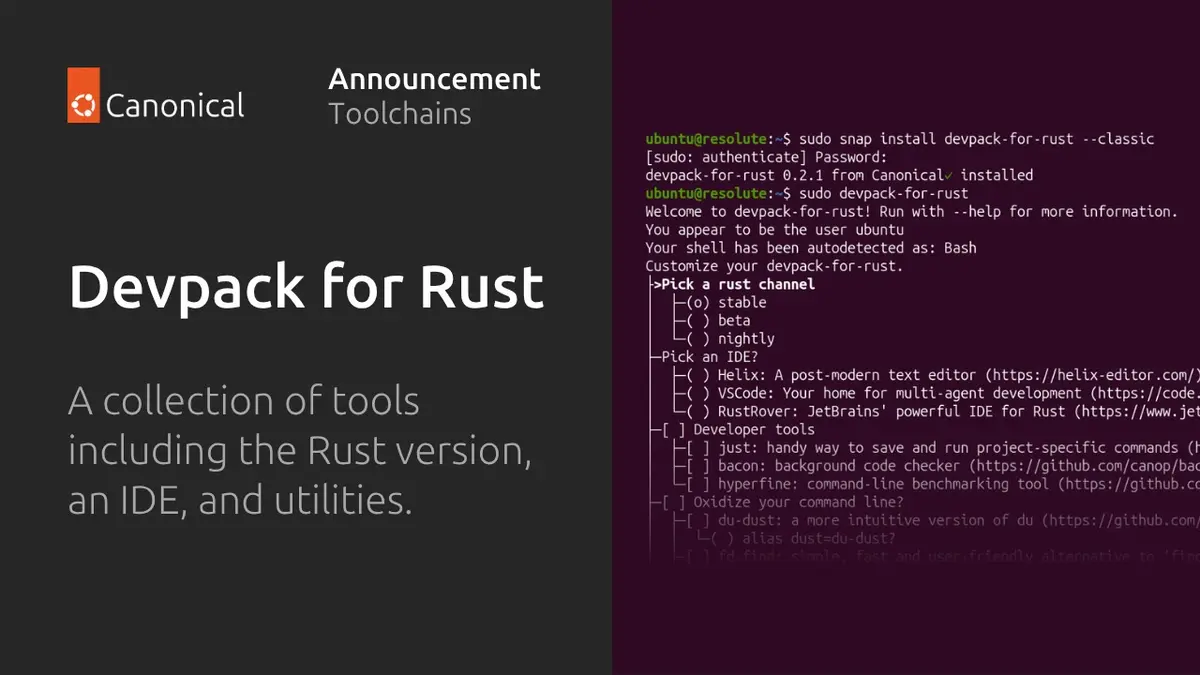
Canonical has packaged a working Rust setup into a single snap. Devpack for Rust, announced on 5 October 2026, installs a chosen Rust release through Rustup, an IDE, and a curated set of command-line utilities without the usual round of tool hunting.
The pitch is speed rather than novelty. Instead of working out which editor, linter, search tool and benchmark binary to trust, a new Rust developer can install one snap and pick from a list Canonical has already vetted. Veterans get the same menu, plus a handful of tools they may not have met.
One command, an interactive menu
Installation is a single terminal command: sudo snap install devpack-for-rust --classic. Running sudo devpack-for-rust then opens a tree of options that is navigated with the arrow keys or HJKL, with space and enter used to choose what to install. The tool sets up Rustup itself and compiles many of the packages it offers.
The bundle leans on Rust-native replacements for familiar Unix utilities. ripgrep and fd cover recursive searching by content and by filename, and just handles project-specific commands that would otherwise become a sprawling Makefile. Bacon, hyperfine and du-dust appear among the optional extras, along with a choice between the Helix, VS Code and RustRover editors.
Part of a wider devpack line
Devpack for Rust is the latest entry in Canonical's devpack series, which applies the same one-snap idea to other language toolchains. The project is open source, and Canonical is inviting issues and pull requests for tools that should join the list.
Our opinion
Rust's onboarding problem has never really been the language. It is the moment a new developer opens the crate ecosystem, finds four ways to do every job, and quietly closes the terminal. A vetted menu does not remove that choice, but it removes the paralysis, which is arguably the harder half of the problem to solve.
The interesting bet here is that snapping a toolchain is worth more than documenting one. Canonical is really selling the same idea as its devpack series generally: that distribution, not compilation, is the friction worth removing. For a language that already has rustup in the installer, that is a narrower argument than it first appears, but it is a sensible one for teams that want identical environments on every machine.