MedGemma puts open medical AI to work in clinics
Google’s open-weight MedGemma models are screening for cervical cancer in Zambia and triaging patients in Delhi, running offline on ordinary smartphones.
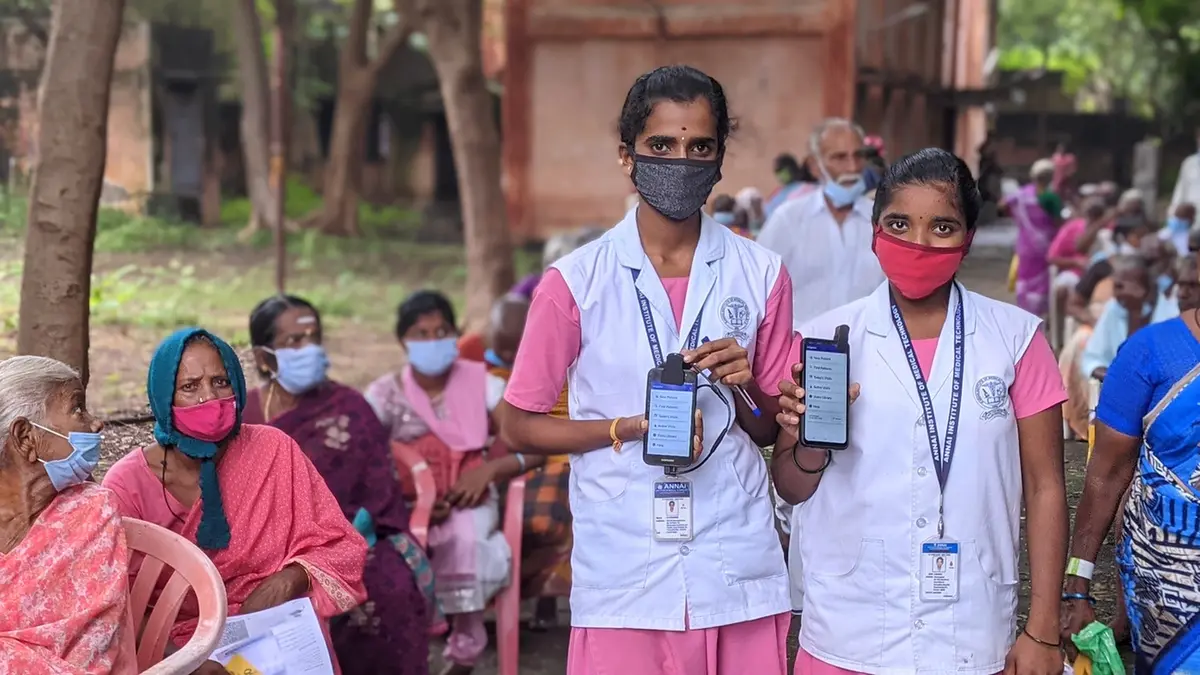
Google has set out how its MedGemma family of open-weight models is being used in the field, roughly a year after the company began releasing models designed specifically for medical text and medical imaging. The post describes deployments across three settings: frontline care in remote clinics, high-volume hospitals, and national public health programmes.
What MedGemma actually is
MedGemma is a collection of models built on Google’s Gemma family and tuned to read clinical notes, answer questions and interpret medical imaging such as X-rays and CT scans. Because the weights are open, an organisation can adapt a model to its own language, conditions and population instead of renting a closed service. The models are small enough to run on a phone, which is what makes the offline deployments possible.
Where it is running
In rural Uganda, Crane AI has built EaseHealth, a clinical decision support app in which an adapted MedGemma model handles the reasoning on the device itself, with no internet connection, so community health workers can review symptoms and guidance where no network reaches. In Zambia, where the cervical cancer rate is among the highest in the world, Dawa Health’s DawaMom app pairs MedGemma with the MedSigLIP encoder and has been used to screen more than 3,500 women. In India, Visilant’s smartphone-based imaging system has already screened more than 50,000 patients for cataracts and other eye conditions, and is now folding MedGemma into that workflow.
Hospitals and ministries
The same family is also being piloted in busy hospitals. Clinicians at the All India Institute of Medical Sciences in Delhi are testing IndusDerma for dermatology screening, built to account for Indian skin tones, and a second AIIMS app called Aarogyam for outpatient triage, with the stated aim of cutting the wait before a specialist is seen by 40 per cent. Google adds that the models can run on-site or on any cloud server, which lets health ministries keep patient data inside their own infrastructure.
Our opinion
The most persuasive thing about this class of deployment is how unglamorous it is. Nobody is claiming a model outperforms a consultant; the wins are triage queues, a screening appointment that happens at all, and a tool that keeps working when the signal drops. That last point is the real argument for open weights in medicine, because a hospital cannot audit, retrain or reasonably trust a model whose internals it is not allowed to see. The caveat worth holding on to is that every figure here is the provider’s own count of its own rollout. What would settle the question is a peer-reviewed comparison of outcomes against the alternative, which is usually no screening at all, and those numbers are still owed.